
Background: The Nazis said enough repugnant things to provide all sorts of quotations, but there are some quotations that people have invented. This page discusses seven quotations that I think are fabricated or misattributed. More examples may follow as I discover them.
False Nazi Quotations
1. “Truth is the greatest enemy of the state” (Goebbels)
This is the most popular forged quotation. The full version:
“If you tell a lie big enough and keep repeating it, people will eventually come to believe it. The lie can be maintained only for such time as the State can shield the people from the political, economic and or military consequences of the lie. It thus becomes vitally important for the State to use all of its powers to repress dissent, for the truth is the mortal enemy of the lie, and thus by extension, the truth is the greatest enemy of the State.”
Last I did a Google search (April 2025), this shows up on 14,000 web pages and hundreds of books (many of which, but not all, are self-published productions, evidence for the value of publishers who still believe in editors). It is attributed to Joseph Goebbels. No one ever gives a citation to the source. A fair number of web citations are to “Joseph M. Goebbels.” That wasn’t his middle initial.
There are several hundred pages in German that cite the statement, but none give a source, and one site (perhaps the earliest) notes that is “retranslated from English.”
Goebbels wouldn’t have said that in public. He always maintained that propaganda had to be truthful. That doesn't mean he didn’t lie, but it would be a pretty poor propagandist who publicly proclaimed that he was going to lie. I know of no evidence that he actually said it. I haven’t read everything Goebbels wrote, but I have been through a lot of it.
The Nazis issued a weekly series of posters with inspiring quotations that were displayed throughout Germany. One from 1940 displays Goebbels’s alleged love of truth in a quotation from his 1933 Nuremberg Rally speech on propaganda:
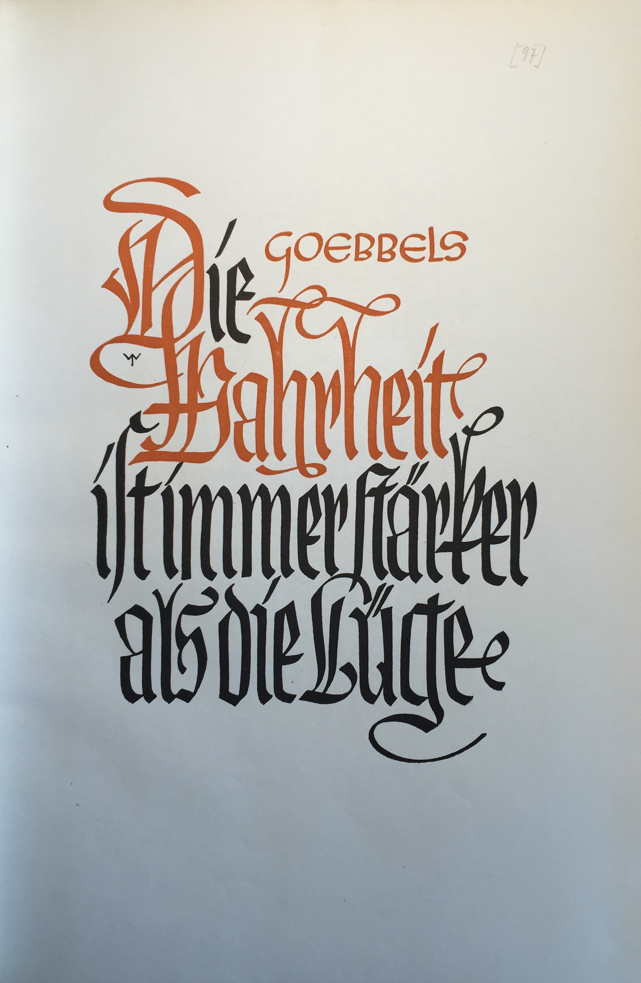
Goebbels actually accused others of using the technique. In a 1941 article titled “Churchill’s Lie Factory,” he wrote:
“One should not as a rule reveal one’s secrets, since one does not know if and when one may need them again. The essential English leadership secret does not depend on particular intelligence. Rather, it depends on a remarkably stupid thick-headedness. The English follow the principle that when one lies, one should lie big, and stick to it. They keep up their lies, even at the risk of looking ridiculous.”
He accuses the English of the “big lie,” and suggests that, were he to use such a technique, he would not publicly announce it.
The quotation usually seems to be used by those on the political left and right, who find it helpful in to associating those they don't like with the Nazis. Since this is so common, my colleague Quentin Schultze and I have begun a blog titled Goebbels Didn’t Say It to follow its spread and, we perhaps too optimistically hope, to reduce its use.
It is related to quotation #3, which is usually quoted accurately, but taken out of context.
2. “Truth is unimportant” (Goebbels)
The following quotation is sometimes attributed to Goebbels:
“There was no point in seeking to convert the intellectuals. For intellectuals would never be converted and would anyway always yield to the stronger, and this will always be ‘the man in the street.’ Arguments must therefore be crude, clear and forcible, and appeal to emotions and instincts, not the intellect. Truth was unimportant and entirely subordinate to tactics and psychology.”
However, it is a summary of Goebbels’s thinking by Hugh Trevor Roper in his introduction to Final Entries 1945: The Diaries of Joseph Goebbels (New York: Putman’s, 1978). p. xx. Once again, although Goebbels was entirely willing to lie when it was useful, he always maintained in public that his propaganda was truthful.
3. Hitler and the “Big Lie”
The false Goebbels quotation above is actually a take-off on Hitler's familiar statement in Mein Kampf, which is often misunderstood. Hitler stated:
“In this they [the Jews] proceeded on the sound principle that the magnitude of a lie always contains a certain factor of credibility, since the great masses of the people in the very bottom of their hearts tend to be corrupted rather than consciously and purposely evil, and that, therefore, in view of the primitive simplicity of their minds, they more easily fall victim to a big lie than to a little one, since they themselves lie in little things, but would be ashamed of lies that were too big. Such a falsehood will never enter their heads, and they will not be able to believe in the possibility of such monstrous effrontery and infamous misrepresentation in others…” (p. 231 of the Manheim translation)
Hitler is accusing the Jews in the Vienna press of this strategy. It is often taken as evidence that Hitler advocated the “Big Lie.” He is, in fact, accusing his enemies of lying.
Now, Hitler was entirely willing to lie — but in public he insisted that he and his propaganda were truthful.
4. Hitler: “What Luck for Rulers that Men Do Not Think”
This alleged quotation by Adolf Hitler is on over 6,000 web pages. I think it is a fabrication, but am still investigating. It is not in Mein Kampf, nor in the Domarus edition of Hitler’s speeches. None of the pages that cite it gives a reliable source. Several cite a book that has it, but said book provides no reference to an original source.
5. Hitler and Gun Control
The following quotation shows up about a 7,000 times on the on a Google search last I checked (21 April 2025):
“This year will go down in history! For the first time, a civilized nation has full gun registration! Our streets will be safer, our police more efficient, and the world will follow our lead into the future!”
However, Hitler never said it, even though fabricated sources are sometimes provided. In fact, the Nazis liked guns, and greatly reduced German restrictions on their ownership.
6. Hitler and “Law and Order”
The following statement is cited less often today than it was during the 1960s, as news of its falsity has gotten around, but it still shows up on a number of web sites:
“The streets of our cities are in turmoil. The universities are filled with students rebelling and rioting. Communists are seeking to destroy our country. Russia is threatening us with her might and the Republic is in danger. Yes, danger from within and without. We need law and order! Yes, without law and order our nation cannot survive. . . . Elect us and we shall restore law and order. We shall, by law and order, be respected among the nations of the world. Without law and order our Republic shall fail.”
There are lot of things wrong with this statement, beginning with the fact that Hitler wanted the Republic to fail, and was open about it. It had its origins in a communist newspaper, and popped up in the movie Billy Jack (1971). For full details, see that most useful book by Paul F. Boller, Jr. and John George, They Never Said It: A Book of Fake Quotes, Misquotes, & Misleading Attributions (New York: Oxford, 1989), pp. 45-46.
7. Hermann Goering on Culture and Revolvers
Goering is often quoted as having said:
“Whenever I hear the word culture, I reach for my revolver.”
This one is also dealt with in They Never Said It. (p. 36). It actually comes from a play by the prominent Nazi writer Hanns Johst titled Schlageter, which deals with the life of a Nazi “martyr.” It is also an unlikely thing for Goering to have said, since he prided himself on his artistic knowledge.
Last edited 13 April 2026